
How Should Buyers Handle Material Substitutions in OEM Grounding Orders?
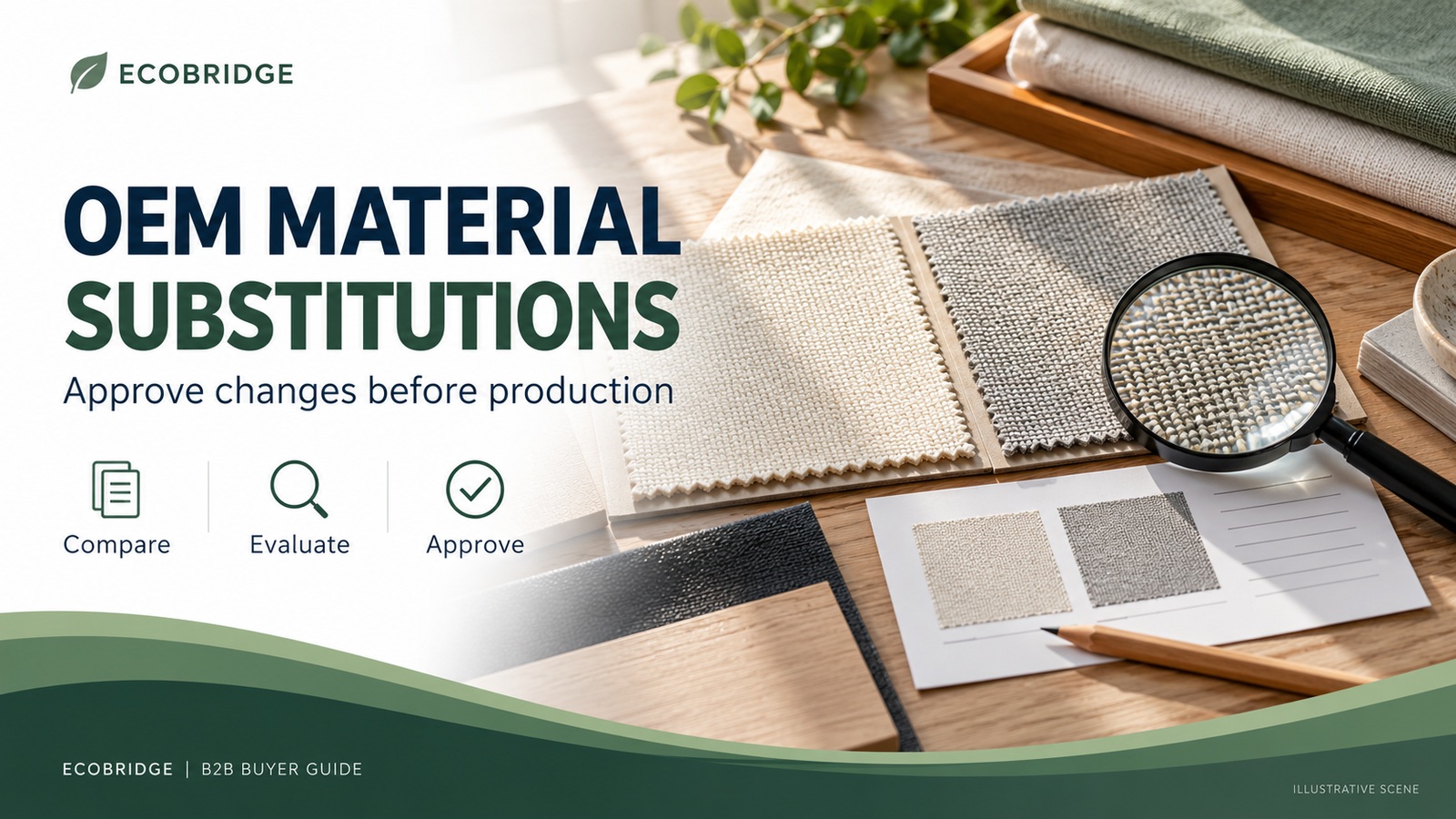
Direct answer: An OEM grounding-product material substitution should be treated as a proposed product change, not as an automatic purchasing swap. Freeze the approved construction, identify exactly what the supplier wants to replace, compare the replacement against the original under the same relevant conditions, review labels and destination-market obligations, and give written approval before the changed material enters production. A supplier’s description of “equivalent” is a starting claim; it is not the buyer’s acceptance decision.
This guide is for importers, private-label brands, and distributors buying grounding sheets, pillowcases, mats, blankets, and complete kits. It gives a practical change-control method, not a universal conductivity limit or a claim about any ECOBRIDGE material specification. The test method, performance criteria, construction, care conditions, and permitted alternatives for a particular order must come from its approved specification and samples.
Reading path: If production is waiting on an unavailable component, start with the six decision gates. If you are assessing a supplier’s evidence, use the change-and-evidence table. If goods have already been made, go to the containment decision. The central question throughout is simple: Will the customer receive the product that was approved, described, tested, and ordered?
When an “Equivalent” Material Changes the Product
Imagine that a sheet sample was approved with one conductive yarn and a specified snap assembly. Before bulk cutting, the factory reports a yarn shortage and offers a similar-looking replacement. Its hand feel is close and a meter gives a conductive reading on a small swatch. That sounds reassuring, but the sample has not yet answered whether the finished sheet will have the same conductive path, withstand the agreed care cycle, match the approved fiber declaration, or perform consistently across the production width.
The opposite can also happen. A supplier changes a carton board grade while the textile, snap, cord, markings, and customer-facing dimensions remain exactly as approved. That still needs to be recorded, but the evidence and approval path can be narrower. A useful change process separates material risk from paperwork volume. It does not put every switch through the same laboratory program, and it does not wave through a critical change because the replacement looks similar.
In this article, substitution means replacing an approved material or component within an existing ordered product. A planned new color or size is a separate sellable variant; see ECOBRIDGE’s color and size variant control guide. A change to how an unchanged component is sewn, coated, or assembled may be a process change. It deserves review too, because it can alter the finished result even when the bill of materials has not changed.
Start With the Change, Then Choose the Evidence
The same phrase, “alternative material,” can refer to very different risks. Use the proposed change’s effect on function, declaration, customer experience, and traceability to decide what to investigate.
| Proposed change | What may actually change | First evidence to request | Likely decision owner |
|---|---|---|---|
| Conductive yarn or fabric construction | Fiber content, conductive-path layout, surface consistency, laundering response, appearance | Old/new material specification, composition evidence, comparable swatches, agreed electrical measurements before and after relevant care | Buyer product/quality lead; label reviewer if composition changes |
| PU surface or backing material | Finish, durability, thickness, touch, printing/adhesion, cleaning response | Material identification, approved-sample comparison, finish and cleaning checks relevant to the mat design | Buyer product/quality lead |
| Snap, cord, or connection accessory | Mechanical fit, continuity through the assembled path, service replacement compatibility, destination-market kit | Part drawing, mating sample, assembled-path and retention checks under the agreed method | Buyer product/quality lead; market specialist where applicable |
| Fabric dye, finish, or adhesive | Color match, skin-contact feel, care behavior, chemical disclosure, label or claim support | Supplier declaration, approved color reference, care comparison, market-specific chemical review where applicable | Buyer quality and compliance leads |
| Outer carton or protective packing | Damage protection, packed dimensions, barcode placement, warehouse handling | Pack drawing, transport/handling assessment appropriate to the distribution route, barcode/artwork check | Buyer packaging/logistics lead |
The table is a triage tool, not a statement that every product has these components or that a specific test is mandatory everywhere. A mat’s conductive surface, for example, may use a different construction from a woven sheet. Review the actual approved design rather than copying another product’s test sheet.
Six Gates Before a Substitution Enters an OEM Order
1. Identify the approved baseline
Ask the factory to name the original part and its revision, the proposed replacement and its supplier, and the first purchase order, lot, and unit affected. Match those identifiers to the approved bill of materials, drawing, material specification, signed sample, test method, packaging artwork, and product listing. A comparison against a memory of “last season’s sample” cannot establish what was actually approved.
This is why sample approval must end with controlled records. ECOBRIDGE’s sample-approval guide explains how to retain a reference for the first production run and later repeat orders. If the baseline cannot be located, pause the claimed equivalence decision and reconstruct it with the buyer and supplier. Otherwise both sides may be comparing the new material against different versions of the old one.
2. Describe the change in customer terms
A good change notice answers more than “new supplier.” State whether the finished article’s fiber composition, surface, thickness, color, fit, conductive path, snap geometry, cord connection, cleaning instruction, skin-contact material, accessory bundle, or packed dimensions may change. Mark each as unchanged, changed, or unknown pending evidence. Unknown is a legitimate status; writing “same” without verification is not.
Trace downstream claims. A listing may say “cotton and silver fiber,” a label may declare a fiber percentage, and a customer-care card may describe a cleaning method. A yarn or finish change can make one of those statements inaccurate even if an initial resistance measurement looks similar. For textile products sold in the United States, the FTC’s Textile Fiber Rule describes required disclosures including fiber names and percentages, responsible business identity, and country of origin for covered goods. Applicability and the final label should be checked for the actual product and market.
3. Compare like with like
Define the comparison before receiving a reassuring number. Measure old and proposed material using the same instrument or validated method, measurement points, contact arrangement, environment, sample preparation, and relevant use or care state. Test the finished configuration where the change can affect assembly. A swatch reading cannot by itself prove that the full path through fabric, snap, cord, and accessory is acceptable.
For conductive textiles, consider the spread of readings across locations, not only the best point. For products sold with care instructions, consider whether the agreed after-care state belongs in the approval. A conductivity report needs the sample identity, condition, method, measurement locations, raw or summarized results, and the acceptance rule. ECOBRIDGE’s guide to comparing conductivity test reports explains why unlike methods and sample states should not be treated as directly comparable. There is no single resistance threshold that this article can impose on every grounding product.
4. Check physical and commercial fit
Build a complete sample using the replacement and compare it side by side with the approved reference. Check the characteristics customers and operators can notice: appearance under agreed lighting, hand feel, dimensions, seam or bond quality, snap fit, cable routing, cleaning response, and packaging fit where relevant. In a multi-SKU line, verify which colors, sizes, and regional kits will use the new component; approving one sample does not silently approve every variant.
Write the acceptance criteria before looking at results. A buyer may accept a changed internal carton material if protection and packed dimensions still meet the order; the same buyer may reject a visible fabric shade shift on a color-matched bedding range. This is a business decision tied to the order, not a generic pass/fail claim.
5. Review market, label, and identifier effects
Ask whether a new composition, finish, component, or pack needs a revised fiber declaration, care instruction, listing, safety statement, customs documentation, or barcode decision. Article 33 of REACH creates supply-chain communication duties for articles containing a Candidate List substance above 0.1% weight by weight; that does not mean every substitution triggers an Article 33 disclosure, but it shows why a relevant material change may require fresh substance information from the supplier. See ECHA’s guidance published by the EU Publications Office.
Do not assume the existing GTIN remains appropriate. GS1’s GTIN Management Standard treats some formulation or functionality changes that affect legally required package declarations and must be distinguished by buyers or supply-chain partners as requiring a new GTIN. The brand owner should apply the relevant GS1 rule to the exact changed trade item. An internal BOM revision and a new GTIN are different decisions.
6. Approve in writing and control the cutover
Record one decision: rejected; accepted for a specified trial lot; or accepted for named SKUs and orders from a defined effective date or lot. Attach the new approved specification, reference sample, test record, label/artwork revision, and disposition of old stock. Make clear who may release production. A factory’s purchasing team should not interpret “sample received” as “mass production approved.”
Keep old and new material lots distinguishable. Receiving, cutting, assembly, inspection, and packing records should show which version was used in each finished batch. If both versions are allowed temporarily, the buyer needs a clear transition rule for mixed inventory, replenishment, customer service, and repeat orders. ECOBRIDGE’s importer packaging guide covers how the final kit and printed material should match the intended market version.
A Short Change Notice That Can Prevent a Long Dispute
For a time-sensitive OEM order, the supplier does not need a polished presentation. It does need a decision-ready record. Ask for one page that identifies: original and proposed part numbers and suppliers; reason for the change; affected purchase orders and variants; first affected material lot; the six customer-facing effects above; comparison samples and test results; proposed label or artwork changes; old-stock disposition; and the date by which the buyer must decide. Attach raw evidence rather than replacing it with an unexplained “PASS” stamp.
The buyer’s response should use the same identifiers. For example: “Approved only for the navy fitted-sheet pilot lot identified in this notice after the revised fiber label and agreed after-care measurements are received; all other SKUs remain on the approved material.” That hypothetical sentence shows the needed precision. It is not an ECOBRIDGE specification or a statement that such a product is available.
Read the Evidence Without Overclaiming It
A material certificate, a laboratory report, and a production inspection record answer different questions. A supplier declaration may identify what was supplied and which substances or fibers it contains, but it does not automatically prove finished-product performance. A laboratory report can support a specified result for identified samples under stated conditions, but it does not prove that every later lot used the same input. An inspection record can connect a production batch to its measured characteristics, but it is only as reliable as its sample identity, method, and traceability.
Ask each document to carry the substitution’s new part number or lot code. If a report predates the proposed material, or names a different construction, its relevance needs an explanation. Similarly, a supplier’s quality-management certificate may describe a management system; it should not be presented as a product approval for a changed fabric, coating, or connector. This distinction helps buyers keep evidence proportional and prevents a folder of impressive but unrelated documents from replacing a clear decision.
What If Production Has Already Used the Substitute?
Do not solve an unapproved substitution by relabeling it “equivalent” after the fact. First identify and segregate affected material and finished units by lot, SKU, and shipment status. Then obtain the same technical, label, and market evidence that would have been required beforehand. Decide whether the goods can be accepted, reworked, relabeled where legally and technically appropriate, diverted to a suitable destination, or rejected. The brand owner should approve the disposition in writing before release.
If the substituted material affects a safety-relevant connection or makes a legal declaration inaccurate, hold the affected stock while qualified technical or market-specific advice is obtained. A later passing spot check may not resolve an incorrect label, incompatible accessory, or inability to trace which units contain the change. The earlier the factory reports the issue, the more options both sides retain.
Seven Questions Buyers Ask About Material Changes
1. Can a supplier change a material if it has the same name on the BOM?
No automatic approval follows from a shared name. Two “silver-fiber fabric” entries, for instance, can differ in composition, construction, finishing, distribution of conductive yarn, and care response. Compare the actual part specifications and finished samples.
2. Is a passing conductivity reading enough?
Usually it answers only a defined electrical question about the tested sample under the stated method and condition. It does not, by itself, establish matching fiber content, appearance, care durability, snap fit, labels, or consistency across future lots. The order’s acceptance plan determines which additional checks matter.
3. Must every substitution be sent to an independent laboratory?
No universal rule requires that for every packaging or material change. Choose evidence proportionate to the changed function, contractual requirements, destination-market obligations, and claim. Independent testing may be valuable for a critical conductive or chemical-related change; a buyer may resolve a low-impact carton change through controlled specifications and packaging checks.
4. Does a change of material supplier count if the specification is unchanged?
It can. The nominal specification may match while process controls, lot variability, finishing, or supporting declarations differ. Record the source change and verify the characteristics that matter before releasing the new supply.
5. When should a new barcode or GTIN be considered?
Review it when the changed trade item must be distinguished in retail or the supply chain, particularly when required package declarations or functionality change. Apply GS1’s rules to the actual case; an internal material revision does not automatically mean a new GTIN, and retaining one is not automatically safe either.
6. Can one approved replacement be used across all colors and sizes?
Only if the approval states that scope and the evidence supports it. A fabric change may behave differently with another dye or construction; a snap or backing change may interact with another size or placement. Name the SKUs and markets covered by the decision.
7. What should be done when the supplier has already built units?
Hold and trace the affected lots, compare them with the approved baseline, review label and market effects, and document a buyer-approved disposition before shipping. Do not treat the fact that production is complete as technical acceptance.
The Buyer’s Final Decision
The most useful question is not “Is the substitute similar?” but “Which approved promises can we still support for every unit we will ship?” If the answer is evidenced and the affected lots are traceable, a controlled change may be acceptable. If the material, testing, label, or cutover remains uncertain, the correct next action is to keep the original approved version or pause the affected order until the evidence catches up.