
Grounding Kit Instructions: A Buyer’s Approval Checklist
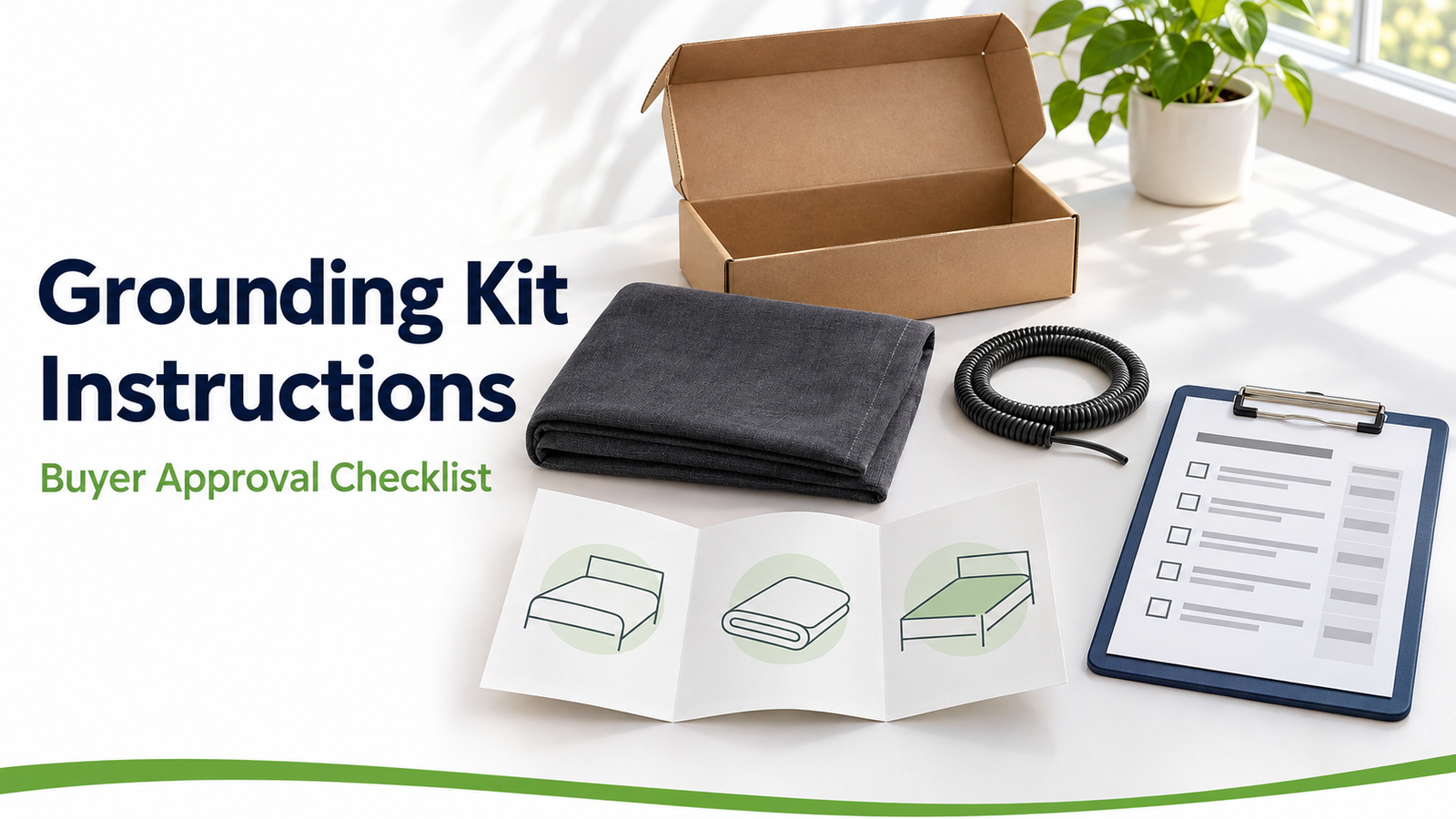
Approve grounding kit instructions against the exact retail pack that customers will receive. A buyer should be able to match the leaflet to the kit, identify the supplied parts and optional accessories, find the conditions for first use, and see what to do if a part is missing or the setup cannot be confirmed. Review the printed insert and any linked digital guide together before approving the production print run.
Start with one packed sample and one instruction revision
Ask the supplier for a production-representative packed sample, the final print proof at its intended size, and the digital guide served by the box QR code, if there is one. Record the retail stock-keeping unit (SKU), destination market, language, leaflet revision, and the part identifiers for the mat or sheet, cord, and any supplied connection accessory. Use the same names on the pack, in the diagram, and in support material. The U.S. Consumer Product Safety Commission staff guide to consumer product instructions recommends identifying the product and model clearly and checking consistency with packaging and other messages about the product.
If the same textile ships in several regional packs, compare the documents separately against each pack. A shared leaflet can work when the applicable version is obvious before the customer follows any steps. If a model or market changes a part, the illustrations and directions should make that change visible. The regional grounding kit BOM guide explains how to keep the pack contents under revision control. Use that record to decide which version of the instructions goes in each carton.
Review the leaflet in the order customers use it
IEC/IEEE 82079-1:2019 treats step-by-step instructions as one part of the wider information a user needs and describes evaluating that information. The checks below apply those general principles to a buyer’s review. Obtain separate evidence for the kit’s technical and market requirements.
| When the customer needs the answer | What to verify | When to hold the leaflet |
|---|---|---|
| Opening the carton | The kit identifier and parts diagram agree with the box. Optional parts are labeled as optional. | The diagram shows an accessory absent from that SKU and gives no way to tell whether it should be included. |
| Before first use | The leaflet identifies the product face or placement where it matters, the approved supplied components, and the supplier’s verified prerequisites and stop conditions. | A generic image makes an alternate component look interchangeable. A prerequisite appears only after the relevant step. |
| Cleaning or storage | The guide identifies the supported care method for this construction, which pieces must be handled separately, and when the product can return to use. | A family-wide care instruction covers products with different materials or supplies an unverified cleaning method. |
| Missing, damaged, or incompatible part | The guide tells the customer to pause and gives a support route that can identify the kit and replacement part by model and revision. | The guide encourages trying alternate parts or adapting the connection without model-specific verification. |
Keep the conditions that affect first use beside the relevant step. If the setup uses a building outlet and its suitability is uncertain, the instructions should direct users to stop and seek qualified local electrical help. If a tester is part of the kit, identify its exact model and the limits of its indications. The guide to socket tester evidence explains why the tester instructions and the finished kit checks answer different questions.
Walk through the instructions without coaching
Use the final-size insert, the packed sample, and a person unfamiliar with the kit. Ask them to show which model the leaflet covers, point out what is supplied, find the step that applies to that version, and locate the stop instruction and support route. Use a disconnected sample for this documentation exercise. The CPSC staff guidance on evaluating instructions recommends observing representative users perform relevant tasks and revising instructions when the evaluation exposes problems. A quick buyer review can identify ambiguous wording. Formal usability or electrical evaluation requires its own plan and qualified personnel.
Record the point where the reviewer hesitates or makes the wrong selection. For example, if readers choose an optional adapter from a shared diagram, revise the specific panel to identify the applicable pack and retest that task. If the underlying component or its suitability is still uncertain, refer the issue back to the product team before approving the artwork. The joint CPSC staff and Health Canada guidance places instructions and labeling within a broader process that also covers design risks, simulated use and production checks.
Release the printed insert and digital guide together
In one hypothetical example, two markets receive the same mat. The paper insert correctly shows the cord in Market B’s carton, but the QR code opens Market A’s diagram. Hold Market B’s leaflet approval. Fix the digital routing or create an unmistakable version selector, then check the printed QR code on a phone to confirm the landing page, language, kit identifier, and revision. Repeat the same review when an accessory, product construction, approved care method, warning, or support route changes.
Record the approved package SKU, market, language, sample reference, print and digital revision, any corrected issue, and the person responsible for release. Keep an accessible copy of the applicable instructions for older packs that remain in circulation. For the next order, ask for that matched approval record alongside the production sample and print proof.
Frequently asked questions
Can one leaflet cover both a grounding mat and a grounding sheet?
Yes, if each section identifies the exact products it covers and the buyer can verify that the illustrations, use conditions and care directions match each packed version. Give products separate sections or leaflets when shared wording would leave the first-use or care decision ambiguous.
Can a QR code replace the printed instructions?
Decide that against the applicable requirements and the kit’s risk assessment. At approval, check what the customer can find at first use without a phone or connection. Keep essential setup conditions and stop instructions accessible at the point where the user needs them, and verify that the digital guide corresponds to the packed version.