
Grounding Sheet GSM: How Buyers Specify Fabric Weight
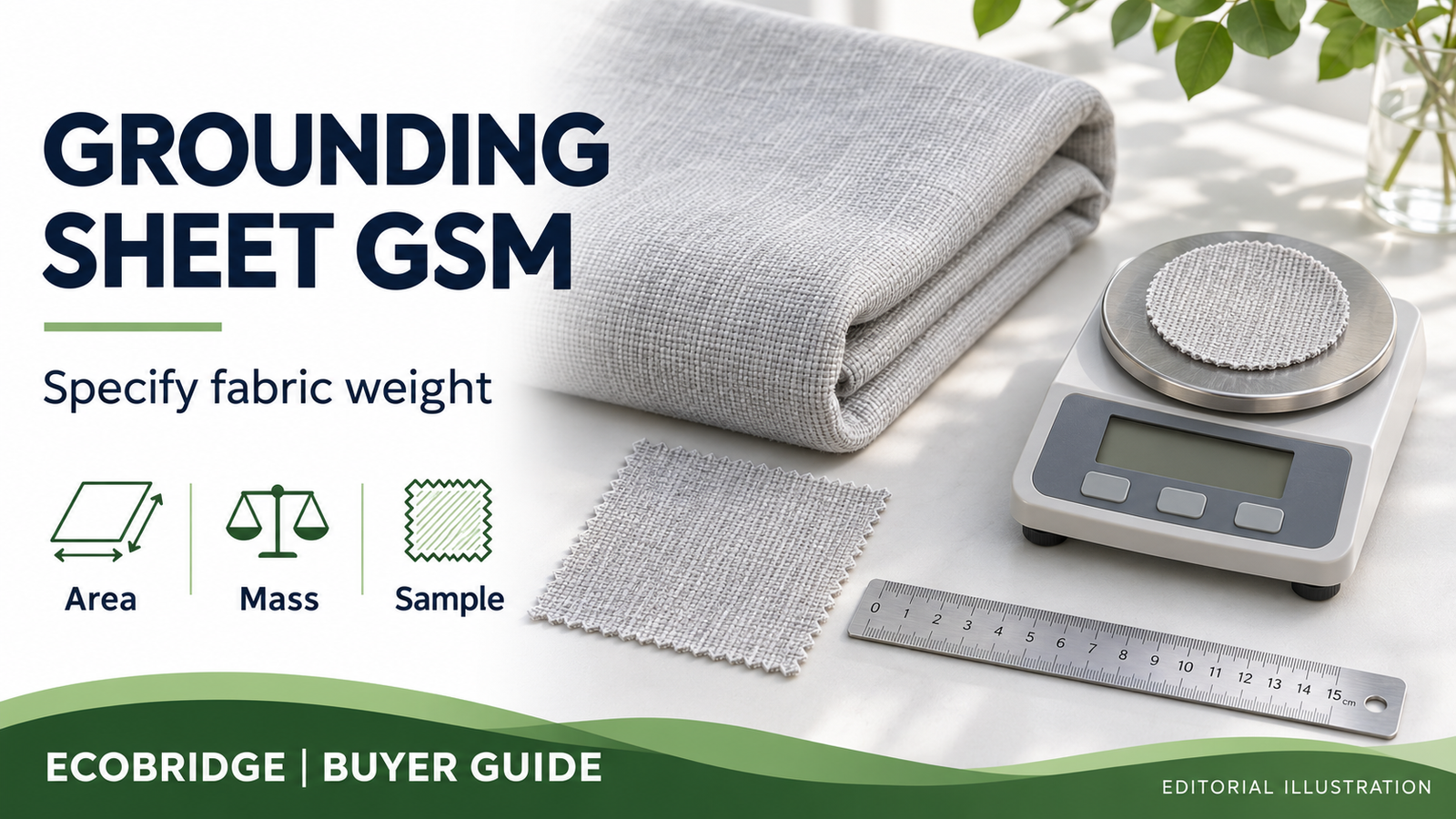
Grounding sheet GSM means the fabric’s mass in grams per square metre. Use it to specify and compare an identified textile under agreed measurement conditions. It does not tell you the weight of a complete sheet kit, how the fabric will feel, or whether the finished conductive path meets its specification.
For wholesale buyers, the practical task is to turn a number on a quotation into a repeatable material requirement. State which fabric is being measured, its production and care state, the method, and the acceptance rule. Then assess the finished sheet and accessories separately. The numbers below are hypothetical examples, not ECOBRIDGE product specifications or test results.
What does a GSM figure actually measure?
GSM is shorthand for grams per square metre, written g/m². It is mass divided by area. A nominal 150 g/m² fabric has a stated mass of 150 grams for one square metre in the specified condition. That description concerns the textile being measured; it does not include a separate cord, packaging or other kit components.
The public scope of ASTM D3776/D3776M-20(2025) covers fabric mass per unit area. Its options address different submissions, including a full piece or roll, a full-width sample and a small swatch. The abstract expressly limits a small-swatch result to the sample, rather than automatically extending it to the originating lot. Ask the laboratory which option and edition it used.
| Figure on the offer | What the buyer must identify |
|---|---|
| Fabric GSM, in g/m² | The defined textile and measurement condition. This is a mass-per-area requirement. |
| Fabric mass per running metre, in g/m | The corresponding fabric width. A length-based figure changes with width. |
| Finished sheet mass, in grams | The complete sewn article, its format, dimensions and included attachments. |
| Packed kit mass, in grams or kilograms | The named sheet, supplied parts and packaging included in the weighing. |
Keep these fields separate in the buying brief. Dividing a packaged kit’s mass by the nominal mattress area does not isolate the fabric’s GSM. A fitted article also contains a construction and fabric area that differ from the mattress’s top surface.
Make the units comparable before comparing quotations
The basic calculation is GSM = fabric specimen mass in grams ÷ specimen area in square metres. For a rectangular specimen, calculate area from its measured length and width. The specimen preparation, measuring equipment and sampling must follow the selected method; the calculation alone is not a complete test procedure.
Hypothetical arithmetic: a specimen with an area of 0.0100 m² and a mass of 1.50 g gives 1.50 ÷ 0.0100 = 150 g/m². These inputs only demonstrate the units. They do not establish a cutting size, balance capability or sampling plan suitable for your order.
A length-based quote needs one more input. If fabric is nominally 150 g/m² and 1.60 m wide, one running metre has an area of 1.60 m² and a calculated fabric mass of 240 g. Another offer of 240 g per running metre is only comparable after confirming its width and what the stated mass includes. A wider fabric can weigh more per running metre while having the same GSM.
For an early material estimate, multiply the agreed GSM by the identified fabric area. Converting that into a finished-sheet or shipping mass requires the actual cut plan, construction, attachments and pack contents. Use a measured production-representative unit for pack planning rather than presenting a fabric-only estimate as a measured kit weight.
Specify the condition and the sample behind the result
Ask whether the quoted figure describes the fabric before finishing, the finished fabric before customer care, or material after an identified care treatment. Record the construction, finish, color and sample or lot reference. A result from an earlier development fabric should not silently become the requirement for a revised sheet.
Moisture history also matters to a controlled comparison. The public scope of ASTM D1776/D1776M-20(2024) concerns conditioning and testing when the selected test method requires it, and explains that previous exposure to humidity can affect moisture equilibrium. Have the laboratory identify the applicable preparation and conditioning. An unrecorded warehouse weighing and a conditioned laboratory result should not be treated as interchangeable evidence.
For sourcing, request the measured values and sample identities as well as any average. Agree how samples will represent the material being purchased. A carefully measured development swatch can help select a textile without establishing that every roll in a later shipment meets the requirement.
A higher post-care GSM can be an area effect
GSM depends on both mass and area. In a simplified hypothetical example, start at 150 g/m² and assume the fabric keeps exactly the same mass while its length and width each decrease by 5%. Its area becomes 0.95 × 0.95 = 0.9025 of the original area, giving approximately 150 ÷ 0.9025 = 166.2 g/m².
This is a mathematical illustration, not a prediction for a sheet or a wash method. Real specimens can also change mass, and the actual dimensions and condition must be measured. An increased post-care GSM alone therefore does not show that conductive material was added, that durability improved or that fit remained acceptable.
Choose an acceptance rule before receiving the results
There is no universal GSM target or tolerance established here for grounding sheets. Select an offered construction that suits the intended bedding, then agree its target and decision rule with the supplier and technical reviewer. A generic range borrowed from apparel or towels does not settle a bedding order.
| Specification field | What to settle before approval |
|---|---|
| Material identity | Exact fabric reference, fiber declaration, construction, finish and revision. |
| Target and units | Nominal mass per area in g/m²; keep g/m and finished-unit mass in separate fields. |
| Test state and method | Production/care state, method edition and option, preparation and conditioning. |
| Acceptance basis | Agreed limits and whether they apply to individual results, a defined average or both. |
| Sampling and disposition | Which specimens represent which lot, who reviews exceptions and how a repeat is recorded. |
Hypothetical purchasing rule: a buyer and supplier agree on 150 g/m² with a tolerance of ±5%, giving limits of 142.5–157.5 g/m². That tolerance is an example, not an industry requirement. The agreement must also say how the limits apply. An average within the range does not automatically authorize individual values outside their own required limits.
If a submitted result falls outside the agreed rule, preserve it and review the sample identity, method and condition before deciding on a repeat or a material investigation. A repeat should explain what changed and why; it should not erase the first result. Hold the affected approval question until the agreed disposition is recorded.
Keep fabric weight separate from feel and electrical performance
A weight match closes one specification question. It does not make two constructions equivalent. Review actual fabric samples for the qualities your customers need, including their feel and drape, and assess the finished format and fit. The cotton versus bamboo-based sheet guide explains why material identity and a complete construction comparison matter.
Electrical measurements address a different quantity. For example, the public abstract of ISO 24584:2022 describes a non-contact method for conductive textile sheet resistance. A fabric mass-per-area result supplies no such resistance measurement and does not assess the complete sheet connection. Use the finished-sheet conductivity testing guide for that separate approval discussion.
In a hypothetical comparison, two fabric options both meet the agreed 150 g/m² requirement. One offer still lacks results for the quoted finished sheet and connector. Record its fabric-weight result as useful evidence, while keeping the finished-function decision open. Neither matching GSM nor a preferred feel substitutes for the missing result.
Questions buyers often ask
Can the same GSM be used for cotton-based and rayon-based options?
The unit is the same, but matching mass per area does not establish matching feel, construction or function. Choose between the identified samples and complete offers. Do not attribute every observed difference to the base fiber when the construction and finish also differ.
Should the fabric and the finished kit have separate weight records?
Yes, when both figures are needed for the purchase. Record fabric GSM for material control and measured unit or packed mass for the defined selling unit. State which attachments and packaging are included so the shipping or merchandising team receives the right figure.
Does a heavier replacement fabric need another review?
Compare it with the approved material requirement and assess the consequences of the proposed change. Review the affected fit, feel, care, construction and functional evidence rather than accepting a higher GSM as an automatic upgrade. Record the accepted revision before it enters the order.
When discussing ECOBRIDGE sheet formats, bring the fabric reference, intended dimensions, proposed GSM requirement and requested measurement evidence. Confirm the actual offered specification during sampling. A clear mass-per-area field makes quotations more useful while leaving the finished product’s other approval questions visible.