
What Should Importers Check in Grounding Product Packaging?
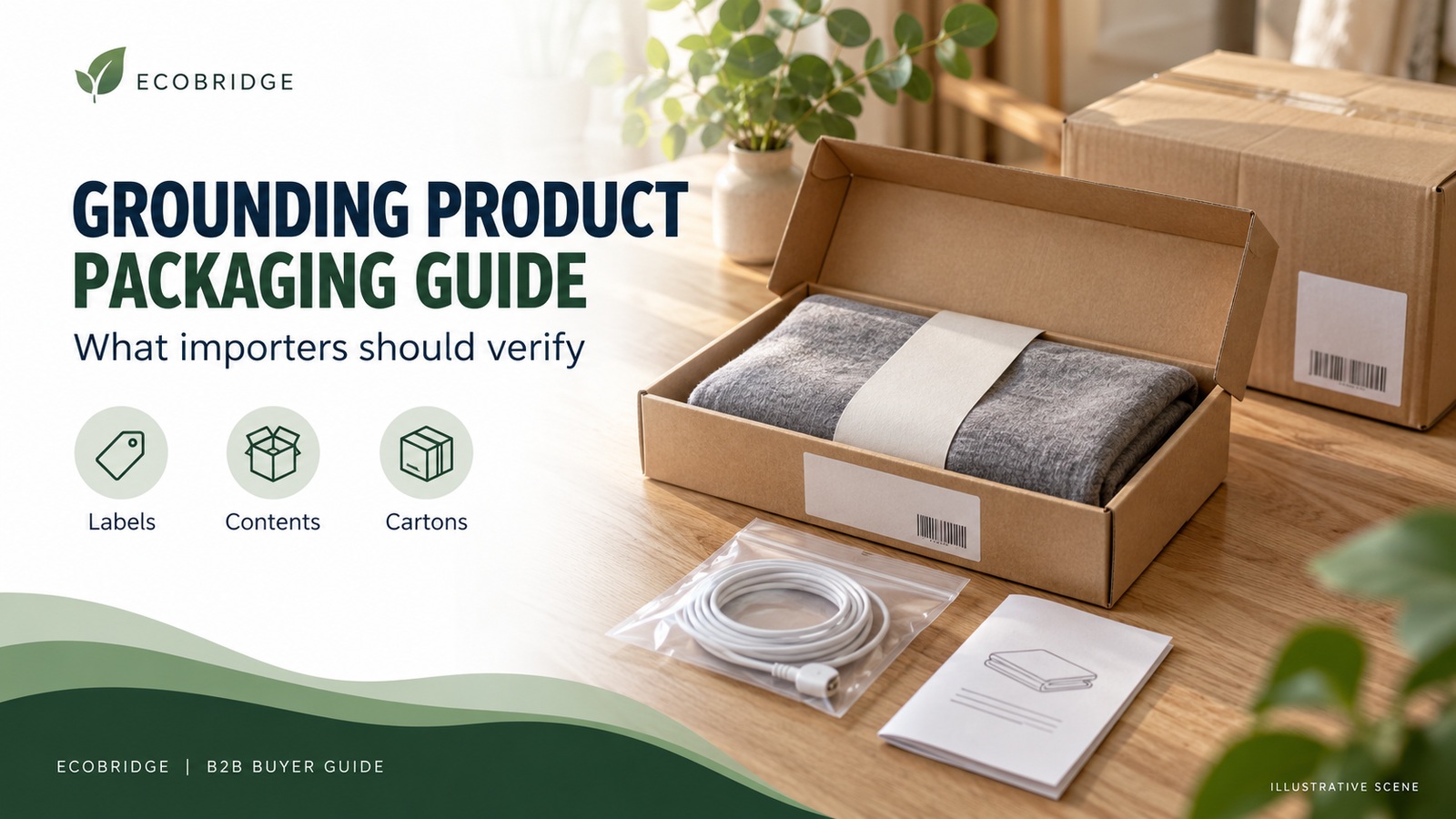
Direct answer: Approve a grounding product’s packaging only when the retail unit, product label, instructions, included accessories, barcode, and shipping carton all describe the same sellable SKU for the intended market. For a grounding sheet, mat, pillowcase, blanket, or kit, a good-looking box is not enough: the buyer needs to know exactly what is inside, how the customer will identify and use it, and which version can be traced if a problem is reported.
This guide is for importers, distributors, retailers, and private-label brands reviewing packaging before bulk production. It is a procurement review method, not a universal label specification. Applicable rules depend on the product and destination. Have the responsible importer or qualified market adviser confirm required statements before artwork is released.
A Three-Minute Reading Path
Start with the customer’s first interaction and work outward to the master carton:
- Open: Does the physical pack contain the exact product and accessory set promised on the front and in the listing?
- Identify: Can a buyer distinguish material, size, color, connector, and market version without opening multiple boxes?
- Use: Are setup, care, and safety information clear for that version?
- Trace: Can a complaint or return be connected to the correct SKU, production lot, and approved artwork?
- Ship: Do inner packs and export cartons protect and identify the units they actually contain?
This sequence is more useful than approving a flat artwork file on its own. A carton can print the correct product name while hiding the wrong cord or an outdated insert. Conversely, a physical sample can be functionally correct while its size label, barcode, or origin statement is wrong.
The Unboxing Error That Creates Two Different Products
Consider a private-label mat sold in two destinations. The black mat and snap may look identical, but each market’s retail kit uses a different approved connection accessory and instruction version. If a factory packs the correct mat with the other market’s cord, the outer box can still look perfect. The error is invisible until the customer opens it.
The practical control is a pack-to-product matrix: for each sellable SKU, record the product revision, accessory part numbers, insert language/version, label artwork, barcode, retail pack format, and case-pack quantity. Keep one approved packed sample, not just a flat dieline. ECOBRIDGE’s grounding kit BOM and regional SKU guide explains why accessory versions should be controlled at SKU level.
| Layer to inspect | Question for the buyer | Evidence to compare |
|---|---|---|
| Product and sewn or attached label | Is the physical format, size, material description, and identity correct? | Approved product sample, specification, label proof |
| Accessories | Are the supplied cord, connector, plug or other parts the approved market set? | Accessory BOM, part photos, pack-out record |
| Insert and care information | Can the customer set up and care for this exact version? | Controlled instruction and care revisions |
| Retail pack | Do front, back, side, and barcode panels describe the contents accurately? | Print proof and assembled pack sample |
| Inner and master carton | Can warehouse staff identify and count the correct SKU without guessing? | Carton marks, case quantity, scan test, packing list |
First, Separate Product Labels from Marketing Artwork
A box, sewn label, hangtag, instruction card, and online listing serve different purposes. A retailer may change the box design while the underlying product label remains fixed. An importer should decide where each required or useful statement belongs and check whether that location is acceptable in the destination market. A QR code can help customers find more detail, but it should not be assumed to replace information that must physically accompany a product.
For U.S. sales, the Federal Trade Commission explains that many household textiles, including bedding such as sheets, blankets and pillowcases, are covered by textile labeling requirements. Its guidance addresses fiber content, country of origin, and the identity of the manufacturer or another responsible business. Product classification matters: a PU mat, a textile mat, a pillowcase, and an accessory kit should not all inherit one generic label without review. The FTC textile labeling guide also explains that packaging alone is not always the proper place for the required product label.
For EU sales, the European Commission’s product safety overview is the starting point for identifying applicable obligations. The General Product Safety Regulation and any product-specific rules may affect product identification, responsible-business information, instructions, warnings, and language. The importer should map these obligations to the exact product and sales channel instead of copying a U.S. carton.
Buyer decision: make a market-by-market artwork register. Mark each statement as legally required, retailer required, operationally useful, or optional marketing copy, and record who approved it. A statement can be helpful without being a legal requirement; the distinction prevents teams from treating every packaging preference as a compliance rule.
Then Audit What the Customer Actually Receives
The product name on a box should agree with its physical construction. A flat sheet should not be pictured as a fitted sheet. A pillowcase size should use a defined finished measurement, not only a local name such as “standard.” For a mat, the image should show the correct surface and connector position. For a bundle, the front-panel “included” list should count every cord, plug, tester, pouch, or other part that really ships.
Build a simple claim-to-component check: every pictured or promised component gets a line in the approved BOM and a tick during sample pack-out. The reverse check matters too: a part inside the pack should have an intelligible description in the instruction set. This catches the common mismatch where a cord appears in the listing but not in the box, or an instruction names a connector that was changed after artwork approval.
The connector and cord guide explains why the complete connection route must be reviewed, while the sample approval guide shows how to retain the agreed physical reference. Packaging approval should be attached to that same sample revision.
One Packaging Rule Does Not Fit Every Product Format
A buyer can use the same approval method across a range, but the failure points differ. For a pillowcase or sheet, verify the finished dimensions and whether the pack image represents the actual shape and closure. A material description on a sleeve cannot substitute for checking the product label and the agreed textile construction. A folded sheet may also hide the connector in a way that makes the supplied connection route unclear to a first-time customer. Opening the packed production sample is the only way to see that experience.
For a PU-surface mat, confirm that the photographed finish, connector location, and included connection parts match the physical SKU. The fold and insert should not press a hard part into the surface. A printed phrase such as “leather” or “fabric” must agree with the approved material description; do not infer a material from appearance. For a blanket, the larger folded volume can change both retail-pack dimensions and case count, while the care card may need more prominent placement. For a multi-item kit, the accessories and regional instructions often deserve the most attention because one missing part can make an otherwise correct pack unusable.
This is why the packaging register should have a format-specific risk column. It tells the inspector which characteristic to check in every pack, instead of applying one generic carton checklist to a mat, pillowcase, and blanket. The PU versus fabric mat comparison can help buyers decide which material description belongs on a particular mat version; the approved physical sample remains the controlling evidence.
Barcodes Are an Identity System, Not Decoration
A barcode must point to the correct sellable item. If two sizes or colors have different retail listings, reusing one code makes picking, receiving, returns, and marketplace data less reliable. GS1’s guidance on size and color variations states that each product variation needs its own GS1 GTIN. Its pack and case guidance explains why changing the number of trade items in a case can require a new GTIN at the higher packaging level.
The buyer should therefore distinguish the consumer unit code from the case code and the factory’s internal SKU. Test the actual printed barcode on a folded or curved production sample, not only the digital proof. Match the scan result to product name, size, color, bundle contents, and market version in the buyer’s product database. If the carton has a separate code, verify its count and contained consumer GTINs.
Information gain: add a “barcode ownership” field to the packaging register. The brand, distributor, and manufacturer may use different internal item numbers, but only one party should control the published GTIN assignment and the product data sent to retailers. This avoids duplicate codes when an OEM order changes hands.
Keep Claims Inside Their Evidence Boundary
Packaging is advertising. A phrase, symbol, photograph, or comparison can communicate a claim even if the copy is short. The FTC’s health products guidance applies truthfulness and substantiation principles to claims conveyed on packaging and labels as well as online. A conductivity reading for a specified test route does not, by itself, establish a sleep, pain, or disease benefit. The phrase “certified” should not be printed unless the exact product, certificate scope, issuing body, and market use of the mark support it.
Use an artwork claim ledger rather than approving copy by visual preference. For each claim, record the exact words or icon, the evidence file, the product revision covered, the destination market, and the approver. A claim without an adequate source should be removed or rewritten before print. This control also catches apparently minor words such as “organic,” “antibacterial,” “medical grade,” or “universal,” which can imply facts not established by a material specification.
Test the Pack as a Physical System
Artwork review does not show whether a folded conductive sheet is strained, whether a snap rubs against the package, or whether a cord presses into a coated mat during storage. The packaging trial should use the actual finished product and accessories. Check fold direction, contact with hard components, closure, moisture protection where relevant, and the condition after the agreed handling or transit simulation. Do not promise a universal drop-test pass; choose a test suited to the pack, route, and retailer requirements.
Ask for photographs of the approved pack before sealing and after opening. This makes the pack-out order reproducible. If a clear window exposes a product, verify that the visible color and construction match the printed image. For fulfillment programs, measure the packed unit and carton after final materials are chosen; a small change in inserts or folding can change chargeable dimensions or the number of units per case.
Record the conditions under which a packaging result was obtained. A supplier’s successful trial on an empty box says little about a box containing a folded blanket and hard accessories. Likewise, an intact master carton does not prove the retail units inside kept their labels readable or their surfaces unmarked. Decide in advance what damage is unacceptable, which samples will be opened, and whether the sample represents the production material and pack-out sequence. Keep photos of both the outer carton and the opened units so the result can be reviewed later.
Follow a Change Through the Whole Pack: A Worked Example
Imagine a private-label pillowcase offered in two sizes. The brand approves a larger finished size after receiving the first packed sample. That change is more than a line of copy on the front panel. The buyer should check the new finished-size tolerance in the product specification, the size on the product label, the size and photo on the retail pack, the listing data sent to retailers, and the GTIN assignment for the new sellable variation. A different fold may also change the retail pack depth or the units that fit in a shipping case.
The team can review the change in a short sequence: first, approve the revised physical pillowcase; second, pack it with the current insert and accessories; third, compare every visible size statement and scan the printed code; fourth, measure the finished pack and case; fifth, archive the old artwork and make the new revision the only release version. If the brand sells both sizes, do not relabel the remaining old stock with the new size merely to use existing packaging. The resulting mismatch would survive an artwork-only review.
This example illustrates a broader rule: change control follows the sellable item. A product revision can affect the label, carton, barcode, instruction, product data, and inspection brief even when the graphics barely change. Each owner should sign off on the part they control: the importer on market statements, the brand on claims and GTIN data, and the manufacturer on pack-out feasibility and production version. The precise division belongs in the purchase agreement; the important point is to name an owner for every release decision.
Use a Single Release Gate Before Bulk Printing
The costly moment is often not production of the product; it is printing thousands of cartons for the wrong version. A release gate should bring together five records: approved packed sample, signed artwork version, accessory BOM, market label review, and barcode/product-data check. If any one changes, identify the affected panels and documents before reusing existing packaging stock.
For example, a new cord may require an updated pack-out diagram, instruction illustration, accessory list, and possibly a market version label even if the outer box shape remains unchanged. A size change may alter the GTIN, front-panel size statement, fold pattern, and carton count. An updated textile composition may affect the sewn label, box copy, product listing, and claim evidence. The change review should name every dependent document rather than asking only whether the design still looks acceptable.
Use ECOBRIDGE’s private-label sourcing guide for the wider OEM specification, then attach the final packaging register to the purchase order and pre-shipment inspection brief. The result is a repeatable approval record, not a one-off artwork signoff.
Frequently Asked Questions
Can one retail box design cover every grounding product variant?
A shared design system can work, but each sellable SKU still needs accurate size, material, color, contents, barcode, market version, and any required statements. Use controlled variable panels or labels only if they remain readable and acceptable for the destination.
Is a supplier’s digital packaging mockup enough to approve bulk production?
No. Review a printed or production-equivalent pack containing the approved finished product and accessory set. Check the fold, closure, text, barcode scan, component count, and condition after realistic handling.
Does the U.S. textile rule apply to a grounding mat?
That depends on the mat’s construction and product classification. The FTC guidance covers many household textiles and floor coverings, while some coated materials have specific treatment. The importer should review the exact SKU, not apply a bedding label automatically to every mat.
Can a QR code replace printed instructions or labels?
Do not assume so. A QR code can supplement setup content, but physical labeling and accompanying information requirements depend on the product and market. Confirm the applicable rule and retailer policy before moving essential information online only.
Should each size or color have its own barcode?
GS1 guidance treats each sellable size and color variation as a separate trade item needing its own GTIN. Confirm the brand’s numbering plan and test the printed code against the correct listing and case data.
What is the most important packaging check for a regional kit?
Match the accessory part numbers and instruction version inside the box to the market identifier outside it. A correct textile product with the wrong cord, plug, or insert is still the wrong retail kit.
When must artwork be reviewed again after sample approval?
Review it when a change affects product identity, material, size, color, accessory set, claims, instructions, responsible-business details, barcode, or case quantity. Record the impact on every linked document before printing or packing resumes.
Buyer Takeaway
Grounding product packaging should be approved as a linked information and delivery system. Begin with the exact physical SKU, then reconcile its labels, accessories, instructions, retail artwork, barcode, and shipping carton. Check destination-market obligations and claims separately, and retain a complete packed sample as the reference for production and repeat orders. That gives importers a practical way to prevent a correct product from becoming an incorrect retail unit.